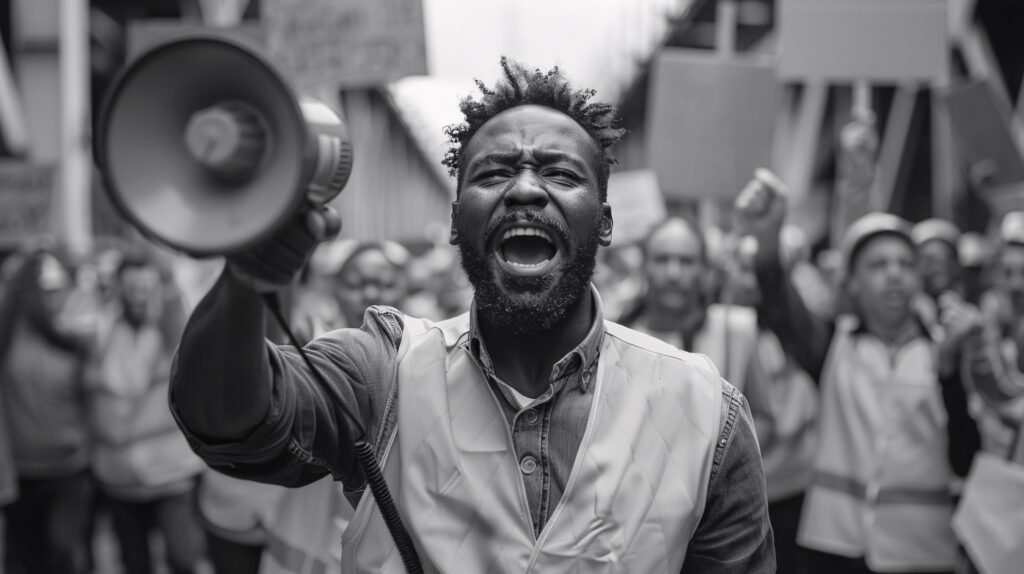
The current generation of young people, though highly heterogenous, has developed a collective rebellion against what they perceive as unresponsive systems of governance. They threaten the established structures of value, authority and power. Through collective action they have carried out political diagnosis, exposed institutional failure and challenged not only ‘corruption’ in the abstract but also the everyday infrastructures through which inequality is sustained and reproduced; such as legislation, public service delivery and political immorality. Gen Z activists, in a revolutionary way have fought against impunity through creative practices that reanimate political realities.
In the midst of these revolutions, one word repeatedly emerges as the object of blame; “the system.” It has dominated the political discourse and created the illusion that the system is a rigid fortress; an untouchable and immovable force beyond the influence of the ordinary citizens. It has reinforced the belief that efforts to bring about change are futile. But what exactly is the system? Is it living or non-living? Does it consist of people, or is it an abstract construct? Or is it both at the same time, something that exists through people, yet also operates beyond any single individual’s control?
Influential scholars David Eston and Karl Deutsch, in defining the Systems Theory they described, systems as political and social structures that sustain the soul of the country. They shape how power operates and how it lives. That means governments, courts, the economy, education, policing, public services and even social norms, all interrelate.
That said, systems are often thought of as a group of powerful people in control somewhere. But in reality, systems are a creation of the people. They shape how people think and behave. How they vote, perceive, connect with each other and make everyday decisions. The relationship between people and systems is a quid pro quo: each reinforces and sustains the other in a continuous exchange. Ideally, people reinforce systems through their beliefs, habits, decisions and reactions. So, the system depends on people to exist and they depend on it to exist. This raises a difficult question: if people are both the creators and carriers of a system, can they dismantle it without, in some way, undoing the conditions that also sustain them?
For instance, can people dismantle the rogue religious systems without challenging their own beliefs and values? And in political systems are we ready to move beyond the politics of ‘waves’, revenge, emotions and tribe? While the youth maybe united in purpose, the established system modelled post-independence which has evolved to adapt to the contemporary realities, still retains its initial structures, foundation and power architecture. Although it has addressed challenges in a limited way, across corporate, politics, and trade, it often reproduces similar patterns of continuity and constraint. So then, can the youth cause a rupture in the system or will they end up reinforcing continuity. What will it take to bring meaningful change?
Statistics always show that the youth everywhere are driven by one thing, identity. They are pursuing autonomy. Yet while they converge around the idea of change, their definition of change is relative and they differ on the methodology of achieving that change. Some identify as reformists, others as revolutionaries and others as reactionaries. The tension between these viewpoints, unless resolved, tend to weaken their momentum and blur their collective direction.
Let’s look at different political identities and their perception of change. A reactionary is someone who wants to return to a previous system or past order they believe was better. A reformist supports gradual improvement of the existing system rather than replacing it completely. A revolutionary seeks to fundamentally replace the existing political, economic or social system with an entirely new one.
Reactionary politics situates the youth within a historical imagination creating nostalgia for a past they were not part of, but which is built largely by narratives of the previous generation portraying the past as the better than the present. Many are emotionally anchored to an inherited notion of political success, without having physically lived through it. This generation of politically conscious youth often struggles with traditional political ideas and practices, including conventional political structures.
The reformist youth politics, on the other hand focuses on fixing weaknesses within the system rather than replacing it. It emphasizes compromise to achieve stability and often works through political parties, civil society or existing governance structures. The reformist youth politics focus on the concept of sharing power instead of seizing it, with the aim of maintaining status quo. It advocates for more inclusion so that more people benefit from it. Reformists tend to align with the existing political parties, emphasizing that change can only emerge from within the system rather than without. They are inclined to support incremental reforms introduced by regimes and political actors, viewing them as necessary steps toward progress. According to them, the country is not mature for radical transformation.
Unlike the other two groups, revolutionaries advocate for complete transformation of the system. They strongly believe that progressive change within the system can only be achieved through radical and disruptive change. In their view, revolutionary change must be brought about by the people and these changes will be resisted by the ruling elites. As a result, they are hesitant to engage in conventional political systems such as the political parties neither do they trust the institutions as they deem them as embedded within the system. They devote their time to spreading radical ideology and prefer a decentralized leadership due to the belief that previous activists and political actors have been co-opted by opposing camps or absorbed into the very systems they sought to challenge.
The contradiction between reactionary, revolutionary thought and reformist leadership lies in their different understandings of change and power. Different groups, different visions yet one people and one common goal: change. But how do they reconcile their divergent understandings and pursue a unified goal, to change the system?