America will no longer police Kenya and Somalia
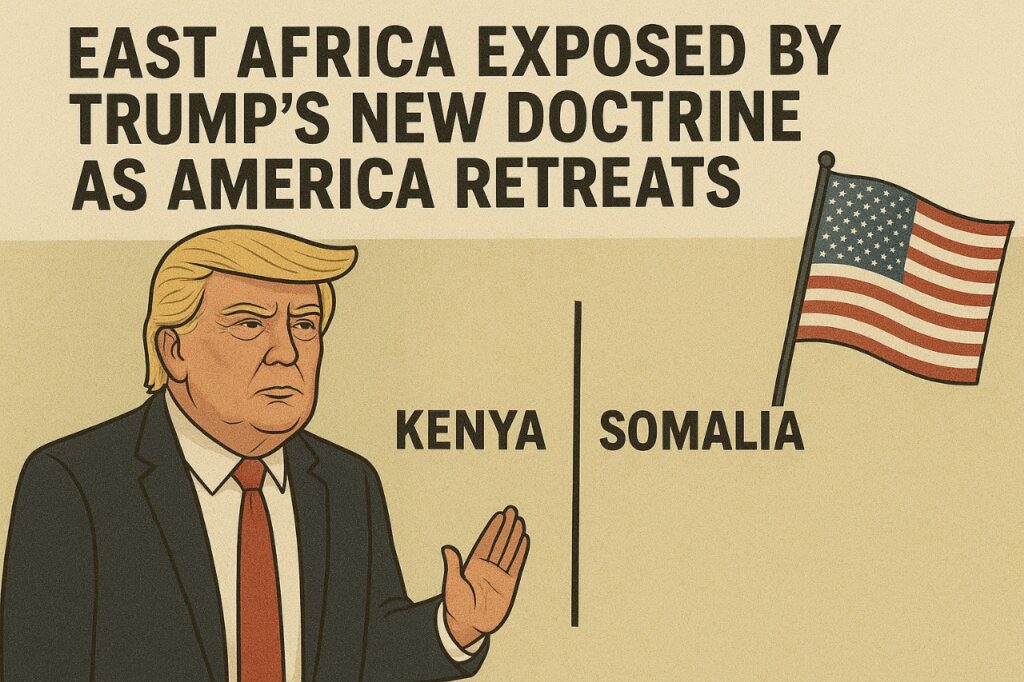
Donald Trump fired a geopolitical thunderbolt across the world: America, he says, will “no longer police Kenya and Somalia.”
For anyone listening between the lines, that was not just a statement; it was a signal flare of retreat. Washington was pulling back its military and intelligence footprint, and in doing so, leaving East Africa dangerously exposed. The United States, the world’s most powerful counterterrorism partner, is packing up its drones, intelligence officers, and war chest. And that means one thing: Kenya and its neighbors are suddenly on their own in a war that has defined the region’s security for nearly two decades.
For years, U.S. satellites, special operations forces, and covert drone strikes have quietly blunted Al-Shabaab’s reach. Washington’s intelligence networks have helped track, intercept, and dismantle terror plots long before they could strike Nairobi, Kampala, or Addis Ababa. That constant pressure, often invisible to the public, has been the thin line between chaos and containment.
Now, that line is fading. And with it, so is the fragile sense of safety that millions of East Africans have lived under.
Historical precedents of terror
We have been here before. Remember Westgate Mall in 2013, the four-day siege that turned a shopping center into a battlefield. Remember Garissa University in 2015, where 148 students were slaughtered in cold blood. Remember DusitD2 in 2019, a luxury complex turned into a war zone.
Each of those attacks was executed with chilling precision, planned by operatives across the border in Somalia, financed through global jihad networks, and coordinated via encrypted communication lines. It was only the constant surveillance and pressure from U.S. and regional forces that prevented dozens more such atrocities.
Now, Trump’s declaration changes everything. His “America First” doctrine translates to “Africa Alone.” It’s a message that Al-Shabaab’s propagandists will seize with glee: “America is tired. The West is gone. The crusaders have fled. East Africa is weak and leaderless.”
For extremist recruiters, that is gold propaganda, a rallying cry that could fill training camps in southern Somalia and radicalization cells in Nairobi, Garissa, and Mombasa. When the world’s superpower signals fatigue, terrorists hear opportunity.
Effect on the fragile economies
Beyond the battlefield, Trump’s pivot will shake the region’s fragile economies. Kenya alone spends billions of shillings annually maintaining troops in Somalia under the AMISOM (now ATMIS) mission, securing its borders, and responding to terror threats. Those efforts have relied heavily on U.S. financial, technical, and logistical backing.
Without that support, governments will face impossible trade-offs. Do they cut education and healthcare budgets to fund counterterrorism? Do they raise taxes to buy ammunition? Or do they leave citizens unprotected, hoping for the best?
None of these choices end well. A withdrawal of American aid could trigger a vicious economic spiral, as insecurity rises, tourism collapses, investors flee, and insurance premiums skyrocket. The cost of living will rise, jobs will vanish, and public morale will sink. Terrorists thrive in that vacuum, when despair deepens and hope fades.
And make no mistake: this retreat does not just endanger Kenya or Somalia. It threatens the entire region’s economic heartbeat, from Ethiopia’s trade corridors to Uganda’s logistics routes and Tanzania’s coastal security.
Where America retreats, others advance. Russia, China, Iran, and private military contractors are already eyeing the vacuum with interest. They will not fill it with generosity; they will fill it with influence.
Moscow will sell arms. Beijing will sell infrastructure and loyalty pacts. Tehran will whisper ideological support for its allies. None of these powers will fight Al-Shabaab for free, or with Kenya’s best interests at heart.
This is how empires shift: quietly, transactionally, one military base and intelligence deal at a time. Trump’s new doctrine does not just expose East Africa to terror; it reconfigures the balance of global power across the continent.
But what’s the Price of Complacency?
We have depended on foreign protection for too long. For years, our leaders have outsourced the war on terror to Washington and Brussels, content to let others fund our safety. That era is over.
This is a wake-up call that cannot be ignored. Kenya and its neighbors must rethink their security architecture from the ground up, with stronger intelligence coordination, better-equipped and better-paid border forces, smarter use of technology, and above all, investment in people.
Radicalization thrives where poverty, joblessness, and hopelessness reign. The best counterterrorism strategy is not just bullets and drones, it’s opportunity. It’s education, jobs, and trust in government. When young people believe in their future, Al-Shabaab loses its foot soldiers.
But right now, our youth are staring into uncertainty. When they see leaders looting security budgets, when they see soldiers unpaid and intelligence ignored, when they see America walking away, they begin to ask dangerous questions. And extremists are always ready with answers.
Trump’s retreat is not the end of the war on terror. It is the beginning of a new phase, one where Africa must finally own its defense.
Kenya, Somalia, Ethiopia, and Uganda must forge a regional security pact, not just to share intelligence but to act together, decisively, and independently. The African Union must step beyond rhetoric and invest real money and political muscle in homegrown security solutions.
If our leaders wait for America to return, they will be waiting as terror cells multiply, as border towns fall under new attacks, as economies bleed.
Lest we forget that History Is Watching
Donald Trump’s decision will be remembered as the moment America turned its back on a frontline it once helped hold. But history will also judge East Africa by how it responds.
Will we scramble in panic, or will we rise in unity and purpose? Will we bicker over blame, or will we invest in the strength and sovereignty that true independence demands?
Because here’s the brutal truth: No one is coming to save us. Not Washington. Not Brussels. Not the United Nations.
The shield is gone. The sword must now be ours.
If we fail to act, Trump’s retreat will not just mark America’s withdrawal, it will mark East Africa’s surrender.
And that, we MUST not allow.

Bill Clinton Oulo
Bill Clinton Oulo is a Health Economist and Policy Professional with over five years of experience in public health research, sexual and reproductive health, and wellbeing economics.
He is a former President of the University of Eldoret Students Organization(UoESO), a Leadership and Governance Mentor, a Youth Leader.
Bill has played a part in the Political space of the Country with the recent one being National Lobby groups Coordinator for Azimio la Umoja Campaigns, 2022.