
A storm is brewing across East Africa and it is no longer a diplomatic drizzle; it’s a full-blown political tempest threatening to undo decades of regional solidarity. The recent abduction of Kenyan citizens by Ugandan authorities, barely months after a similar scandal involving Tanzania, signals the lowest point in relations between the three founding members of the East African Community. The dream of integration, unity, and cross-border cooperation now stands overshadowed by fear, mistrust, and repression.
The Disappearance of Activists Bob Njagi and Nicholas Oyoo
In the latest incident, two Kenyan activists, Bob Njagi and Nicholas Oyoo, vanished in Uganda after attending an opposition rally linked to Bobi Wine’s National Unity Platform. Witnesses recount scenes straight out of a dictatorship’s playbook: men in plain clothes, unmarked vans, and a swift disappearance into silence. Uganda’s police have, as expected, denied any involvement. But the denials ring hollow in a country where forced disappearances have become a grim ritual of silencing dissent.
These abductions mirror the earlier ordeal of Kenyan activist Boniface Mwangi and Ugandan journalist Agather Atuhaire, who were seized, tortured, and dumped across the Tanzanian border earlier this year. The Tanzanian government has yet to offer a credible explanation, while Kenya’s diplomatic response has been tepid at best, more appeasement than outrage. The message is painfully clear: East Africans are no longer safe even in neighboring states.

Kenya, Tanzania, and Uganda once stood as the pillars of East African integration. Their leaders championed free movement, shared trade, and Pan-African brotherhood. But beneath that rhetoric, the rot of authoritarian paranoia is spreading. Border security forces now act with impunity; intelligence agencies behave like cross-border predators; and the political elite continue exchanging smiles at regional summits while citizens disappear in the shadows.
The template of transnational repression within EAC
The diplomatic channels meant to safeguard citizens’ rights have failed. Kenya’s Ministry of Foreign Affairs has been reduced to issuing bland press statements, urging “restraint” even as its citizens are abducted and tortured abroad. Meanwhile, Uganda and Tanzania continue to hide behind denials and bureaucratic fog, confident that their violations will fade from public attention as quickly as they emerged.
This is not diplomacy. This is cowardice masquerading as statecraft.
Every abduction of a citizen by a foreign government without due process is not just a crime; it’s an assault on sovereignty. It’s a message that borders mean nothing, that citizens are expendable, and that justice can be outsourced to fear. When one East African nation can abduct another’s citizens and face no serious diplomatic consequence, what remains of regional trust?

The East African Community (EAC) was built on the principle of solidarity. But what solidarity remains when one member’s security forces kidnap another’s citizens? When governments collaborate in silencing activists, journalists, and whistleblowers, they become co-conspirators in the erosion of democracy.
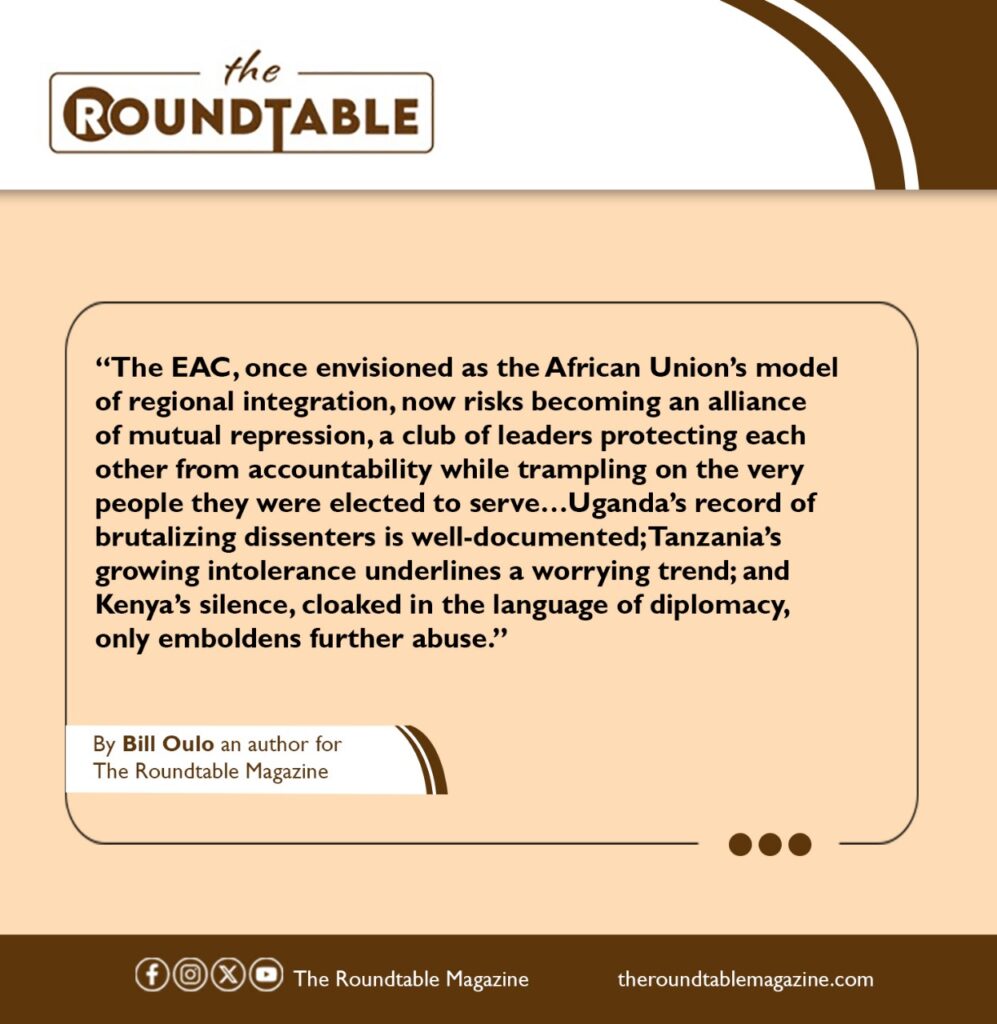
The EAC, once envisioned as the African Union’s model of regional integration, now risks becoming an alliance of mutual repression, a club of leaders protecting each other from accountability while trampling on the very people they were elected to serve.
These aren’t isolated events; they represent a chilling regional pattern. Activists are trailed across borders, journalists harassed for exposing corruption, and human rights defenders smeared as foreign agents. Uganda’s record of brutalizing dissenters is well-documented; Tanzania’s growing intolerance underlines a worrying trend; and Kenya’s silence, cloaked in the language of diplomacy, only emboldens further abuse.
The East African region has, in effect, created a new template of transnational repression, where states cooperate not to promote trade or peace, but to silence critics beyond their own borders. It’s a dangerous precedent, one that chips away at the hard-won gains of democracy and human rights across the continent.
Sovereignty versus Lawlessness
Kenya cannot afford silence any longer. The government must summon the moral courage to demand accountability, not just for its missing citizens, but for the integrity of regional relations. Diplomatic niceties cannot override human dignity. A neighbour who kidnaps your citizens is not a partner; they are an aggressor hiding behind the façade of friendship.
Uganda and Tanzania, too, must recognize that these acts of impunity carry long-term consequences. A government that normalizes abduction today will face isolation tomorrow. Sovereignty cannot coexist with lawlessness. The moral stain of these actions will linger, no matter how loudly denials are shouted in Kampala or Dodoma.

The East African Court of Justice and the African Union must rise from their bureaucratic slumber. Regional justice mechanisms cannot continue as ceremonial bodies while citizens are brutalized. The EAC Secretariat must initiate an independent inquiry into these abductions, backed by international oversight. Anything less would make the regional bloc complicit in its own moral decay.
For the people of East Africa, this is a moment of reckoning. We must demand more from our governments, more protection, more transparency, and more courage to confront injustice, even when the perpetrators are within our own neighborhood.
The abductions in Uganda and Tanzania are more than isolated diplomatic incidents; they are a mirror reflecting a deeper crisis of values within East Africa. They expose the hypocrisy of leaders who preach unity abroad while terrorizing their neighbours’ citizens at home. They reveal a region drifting dangerously close to the authoritarian abyss.
If East Africa is to reclaim its vision of unity and progress, its leaders must first reclaim their humanity. Diplomacy must not be a shield for abuse. Sovereignty must not be weaponized against the weak. And silence, especially from Kenya, must never again be mistaken for peace.
Because when citizens disappear, when borders become traps instead of bridges, and when governments trade compassion for convenience, East Africa ceases to be a community. It becomes a crime scene.

Bill Clinton Oulo
Bill Clinton Oulo is a Health Economist and Policy Professional with over five years of experience in public health research, sexual and reproductive health, and wellbeing economics.
He is a former President of the University of Eldoret Students Organization(UoESO), a Leadership and Governance Mentor, a Youth Leader.
Bill has played a part in the Political space of the Country with the recent one being National Lobby groups Coordinator for Azimio la Umoja Campaigns, 2022.