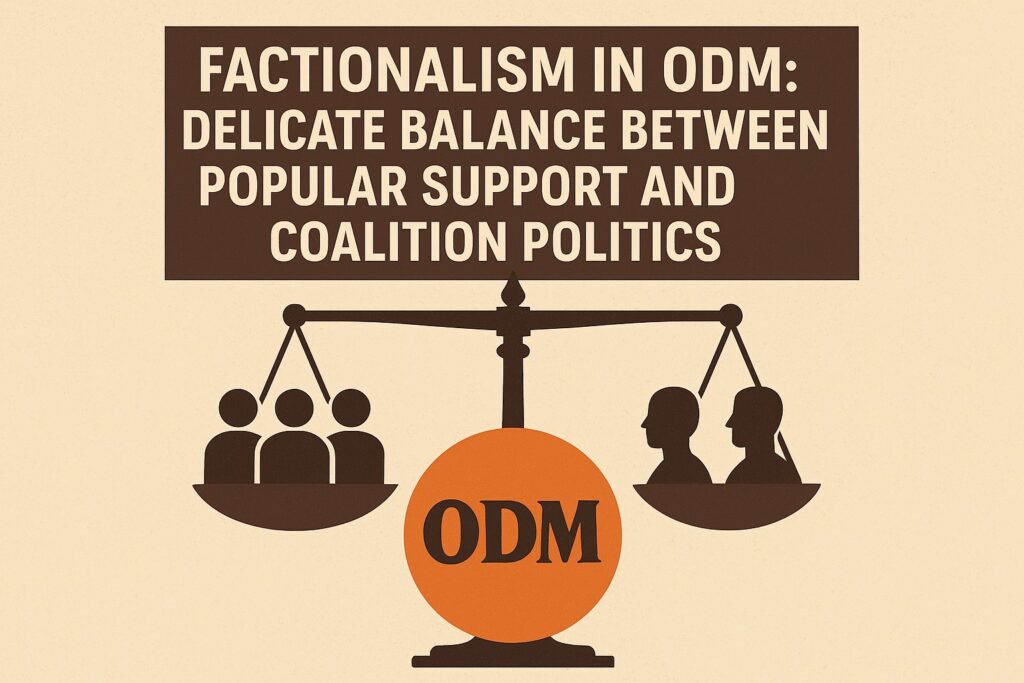
In the last three months since the death of the Late Rt. Hon. Raila Odinga, the Orange Democratic Party has weathered increased internal strife and contradictory impulses, between the radical elements of the party and the longstanding members.
The Orange Democratic Party (ODM) was formed from a coalition of opposition leaders famously christened as the “No team” during the 2005 Referendum. Since then, it has been perceived as a symbol of resistance, a people driven movement for reforms. Over the years loyal supporters have mobilised at the party’s calls and taken to the streets in an act of civil disobedience of perceived oppressive state actions. During these protests, some have paid the ultimate price for the party. As a result, the party has been viewed to transcend traditional politics of being merely a vehicle to capture power into an emblem of people’s sacrifice and collective struggle, grounded in strong ideas and ideals.
While ODM has experienced the usual political struggles, its survival and success have been largely hinged on the dual pillars of popular mass support and engagement with the government of the day, each complementing the other. It commands one of the best grassroot structures that no other party enjoys, and the widespread loyalty to the late Rt. Hon. Raila Odinga have compelled successive governments to recognize and engage with ODM for the stability of the nation. In turn, this engagement has extended the party’s political lifespan and strengthened it.
The former Prime Minister is no longer alive, but his ODM legacy endures, albeit with tension. The very foundations that once ensured its survival are strained and under threat of factional splits and succession battles. However, how can ODM still represent the voice of the people who feel that the party’s original ideological drive has been lost in the face of the ongoing tensions within the Party, while still retaining influence with the current government? The party cannot afford to lose either as it has been built on the delicate balance of both and its continued relevance depends on reaffirming its dual pillars. Without both, the walls of the party may falter, and the legacy of the Late Odinga, risks erosion.
Comparative Analysis of Zimbabwe’s MDC and ANC
Presently ODM is navigating a period of tumultuous internal differences and political uncertainty and it can draw important lessons from its African sister party, the Zimbabwe’s Movement for Democratic Change (MDC), which also experienced similar turbulence following the loss of its founding leader and the former Prime Minister, Morgan Tsvangirai.
Much like ODM, which was birthed from opposition so was the MDC which was formed in 1999 at the backdrop of resistance and desire for change in Zimbabwe. The two parties share similar ideological perspectives and have had similar political experiences. Notably, both have been in Governments of National Unity following allegations of electoral malpractice that plunged both countries into electoral violence, culminating in an internationally brokered settlement that saw both the Late leaders, Hon. Raila Odinga and Morgan Tsvangirai assume the position of Prime Minister.
Similarly, the loss of their leaders created a power vacuum that led to factional rivalry and disputes over the succession to the leadership. In 2018 Nelson Chamisa, the former vice-president of MDC party rose as the new leader following the death of Tsvangirai. The move was swiftly met with opposition from some elements within the party, who questioned his ascent to power, leading to litigation battles for the soul of the party.
Although Nelson Chamisa attempted to unify the party, he was only partially successful as MDC would later split into two splinters; MDC-T, which was the original MDC and Citizens Coalition for Change (CCC) headed by Chamisa. Whereas, the spilt was enabled by the Ruling of the Court that Chamisa’s rise to leadership following the death of the party leader was unconstitutional, one cannot help but attribute the same to underlying factors, including public perceptions that the party had drifted away from its founding mandate and core values.
As at 2026, the shadows of factionalism have followed Nelson Chamisa, who has since resigned from CCC to lead a new movement known as Agenda 2026. Meanwhile, MDC-T has weakened and lacks representation in the parliament, displaying the effects of degenerative factionalism.
A similar pattern was observed in South Africa’s African National Congress (ANC), the party founded by Nelson Mandela and currently led by President Cyril Ramaphosa. Growing factionalism within the party has eroded its political dominance as seen in the 2024 elections, when the ANC lost its majority for the first time since its inception, securing only 40.18% of the vote and subsequently forming a government of national unity. This decline has been partly attributed to internal splits, including the departure of former president, Jacob Zuma, and the formation of the breakaway uMkhonto weSizwe (MK) Party.
The Ideal ODM Party
Those examples clearly depict the adverse effects of internal divisions which destroy the party’s social base as factions are perceived to advance self-interests rather than the well-being of the public. Factions destroy the party in that they leave the party disconnected from the people who had initially supported it and become increasingly distant from the wider movement.
In some instances, the parent party may assume a ‘zombie-like’ existence after breakaway, while in others, the splinter parties lose power after initial prospects of success, driven by their appeal to neglected constituencies and the perception that the original party had strayed from its ideals.
While sometimes in a healthy democracy factionalism may be viewed as constructive, it has degenerative effect if the parties are motivated by self-interests. The Orange Democratic Party should guard against falling into this bait. Although it is embedded in democracy, power to the members of the party to express and make their own decisions can seem democratic but can also have an internal facing problem, undermining its cohesion and mission.
In normal occasions, in the run up to elections the party is always busy focusing on electoral reforms and endearing itself to the people through its agenda. This year, however, it appears preoccupied with a political sloganeering of “Baba said.” There are also whispers of political entrepreneurship, with members of both sides of the aisle fuelling a narrative that some within the party are auctioning it to the highest bidder.
As this political theatre unfolds, the people at the grassroots are watching from the sidelines, awaiting resolution and clear party direction. It must be noted that before entering into any party-to-party coalitions, a political party’s first and most critical coalition is with the people, upon which all other coalitions are built. If the same is not given promptly, the citizens may grow weary of these scripts and finger-pointing. The failure of the party to reconnect with its foundational principles and its people, risks undermining its ability to compete on stronger ground even as it looks toward forming future coalitions.
But also, could it be that history and the future is urging the grand old party to adapt and embrace the younger generation and reinvent itself beyond the old, traditional model to endure beyond the person of the former and late Prime Minister? Ultimately, the buck begins and stops with the party!

Lenah Mati is a Legal and Governance Analyst who brings clarity to political, constitutional, and governance issues. She is recognized for offering insightful analysis on political, legal, and governance issues, both in advisory roles and as a frequent commentator on television discussions on politics, governance, and citizen participation.
With a background in law and public policy, Lenah is passionate about strengthening democracy, promoting accountability, and fostering dialogue between citizens and leaders. Her commentary is known for being practical, engaging and focused on youth-based issues.